

With all due respect to the Seattle Seahawks and the New England Patriots, one could argue that the real competition surrounding the Super Bowl happens off the field – among the brands competing for audience eyeballs during the commercial breaks. Thirty-second ad spots during the Big Game have reached up to $10 million this year – which makes delivering on that investment an extremely tall order for the brands who pay for those spots.
Savvy PR and marketing teams know the real advertising ROI comes from the marketing and PR campaign activities surrounding the event – an approach that can easily be repurposed and scaled for virtually any brand’s campaign, at any budget. That’s because nearly every Super Bowl marketing campaign follows a basic “pre-game, game-day, and post-game” framework.
Let’s look at some of the most successful Super Bowl campaigns in recent years, and how PR teams can leverage the lesson behind them for their own campaign success.
Pre-game: Build curiosity, not just awareness
Super Bowl strategy: Gone are the days when audiences have to wait until the game to know who’s going to be advertising during the event, and what that ad will look like. Weeks before the game, leading brands are strategically dropping “breadcrumbs” like teaser videos and partnering with influencers to build intrigue.
Consider CeraVe’s 2024 Super Bowl campaign, which set up a fake “conspiracy theory” that actor Michael Cera was claiming he invented the company’s signature skin care cream. The brand tapped influencers like Caleb Simpson and Haley Kalil to claim they’d spotted Cera in pharmacies signing bottles of the product. Cera himself appeared on podcasts doing a "hilariously bad job" of debunking the rumors, claiming he had "skin in the game."
Dunkin’ employed a similar tactic for its 2024 Super Bowl campaign, staging paparazzi shots of Ben Affleck and Jennifer Lopez (who were married at the time) at various Dunkin’ locations and releasing social clips of Affleck trying to become a “pop star,” with his fake “DunKings” band. Meanwhile, Doritos began their 2025 “Crash the Super Bowl” campaign at the beginning of the NFL season, inviting fans to help create their Super Bowl ad for a $1M prize. Later they secured local news spots featuring finalists and tapped NFL players to participate in recorded “focus groups” to “test” their reactions to finalist ads.
How to apply it to your PR campaign:
- Create a teaser phase: Before your main announcement (a product launch, a new partnership, a major event), release small, intriguing bits of information. Think "coming soon" social posts, cryptic emails, or a countdown timer on your website.
- Leak information strategically: Not actual leaks, but controlled "drops" of information to key media or influencers under embargo, allowing them to prepare stories that break simultaneously with your main announcement. This builds anticipation and guarantees wider coverage.
- Behind-the-scenes content: Share glimpses of the process, the people, or the passion behind your upcoming news. Such tactics help to humanize your brand, show authenticity, and build credibility with audiences.
- Tap into the power of micro-influencers: While partnering with a big name celebrity can generate buzz, "micro-influencers" (those with smaller, highly engaged audiences) often provide more authentic connection and niche reach. Even though CeraVe leveraged Michael Cera as the “anchor” of its campaign, the brand used a mix of beauty and lifestyle influencers to be the “engine,” helping to spread the "Michael CeraVe" rumors, making them feel organic. Meanwhile, for Dunkin's "DunKings" campaign, the brand had influencers like Charli D'Amelio participating in the brand's larger "Ben Affleck trying to be a pop star" storyline.
- Get audiences in on the action: Empower your audience to become part of the story – with user-generated content contests, interactive polls, or collaborative projects to increase engagement with your campaign. Doritos' "Crash the Super Bowl" contest was a decade-long masterclass in audience-generated content, giving fans a direct stake in the brand's advertising.
Game day: Amplify and engage with your fans
Super Bowl strategy: No brand should stand still on launch day, and this is certainly the case for those at the Super Bowl. Once an ad drops, a brand is on alert to respond to cultural moments, engage directly with audiences, and create shareable content as the event unfolds. Doritos didn't just air the winning "Crash the Super Bowl" ad on linear TV; they released the full commercial on YouTube, promoted the creators across their platforms (inviting them to attend the game), shared behind-the-scenes footage and reactions to the trending hashtag #DoritosCrash.
How to apply it to your PR campaign:
- Assemble your response team: Who do you need on launch day? Bring together social and creative to monitor reactions in real-time. Use media monitoring and social listening tools to track mentions, sentiment, and trending conversations. Be ready to pivot messaging, respond to questions, or capitalize on unexpected opportunities.
- Create shareable content: Prepare bite-sized additional assets designed for social sharing. Think quote cards, short video clips, infographics, or GIFs. Release these throughout launch day to maintain momentum and give audiences multiple entry points to engage with your campaign.
- Engage directly and authentically: Don't just broadcast through a megaphone – listen and participate. Respond to comments, reshare positive reactions, and join relevant conversations. On launch day, dedicate resources to genuine engagement, turning passive viewers into active participants and brand advocates.
Post-game: Maintain momentum
Super Bowl strategy: A Super Bowl ad has a famously short "half-life" – often losing 50% of its buzz within just six hours of the game ending. The brands that stay relevant for weeks are those that treat game day as just the beginning, creating evergreen content and new opportunities for engagement after the main event.
How to apply it to your PR campaign:
- Strategic follow-up content: Plan your post-announcement content well in advance. Consider deeper dives into the news, interviews with key stakeholders, or addressing frequently asked questions. Immediately after revealing the "Michael CeraVe" ad was a joke, CeraVe partnered with dermatologists to reinforce the brand's medical credibility, turning the joke into an educational moment.
- Product launches & merchandise: Capitalize on heightened interest by releasing complementary products, limited-edition merchandise, or exclusive experiences. Take a cue from Dunkin', which didn't just air an ad; they released "DunKings" tracksuits that sold out in 19 minutes and launched the actual "DunKings" song on streaming platforms, extending the campaign's shelf life.
- Extend the narrative: Think about how your initial announcement can evolve into a longer story arc. Can it become a recurring series, an ongoing contest, or lead to a new community initiative? Take for example, how Dunkin' extended the shelf life of its campaign by releasing outtakes and extra footage from its Super Bowl commercial.
Post-season strategy: Planning for the next big win
Super Bowl strategy: The Super Bowl isn’t just a chance to win over new audiences and boost sales: It’s a chance to gather invaluable data that will help identify opportunities to pivot messaging in the moment and inform strategies that lead to future campaign success. Their power plays? They use social listening and media monitoring to see exactly which tactics worked and pivot their messaging appropriately..
How to apply it to your PR campaign:
- Monitor sentiment and adjust where needed: Don't just count mentions; look at sentiment. If your data shows that a secondary character in your ad is getting all the love (like the "Michael CeraVe" conspiracy theorists), lean into that character for your follow-up emails and social posts. If sentiment analysis reveals confusion or a specific "pain point" in the reaction, you can release a "clarification" post or a fun FAQ video that addresses the feedback, turning a potential PR hurdle into a moment of brand transparency.
- Discover new narratives: Use media monitoring tools to identify which journalists or outlets are writing about your campaign with the most enthusiasm. Instead of a generic "thank you," reach out with an exclusive "part two" story or behind-the-scenes data. This turns a one-time news hit into a recurring narrative.
- Capture “shadow" conversations: Many brand conversations happen without the brand being tagged. Use tools to monitor keywords, common misspellings, and even visual logos in photos (visual listening). This allows you to jump into conversations you otherwise would have missed, surprising fans with a direct response and creating a "viral" customer service moment.
- Build a playbook for next time: The most valuable output of a long-tail campaign isn't just the sales - it's the data. Use post-campaign analysis to see which influencer types had the highest ROI, which platforms drove the most website traffic, and at what point the "buzz" started to fade. This becomes your blueprint for your next launch, ensuring you aren't starting from scratch.
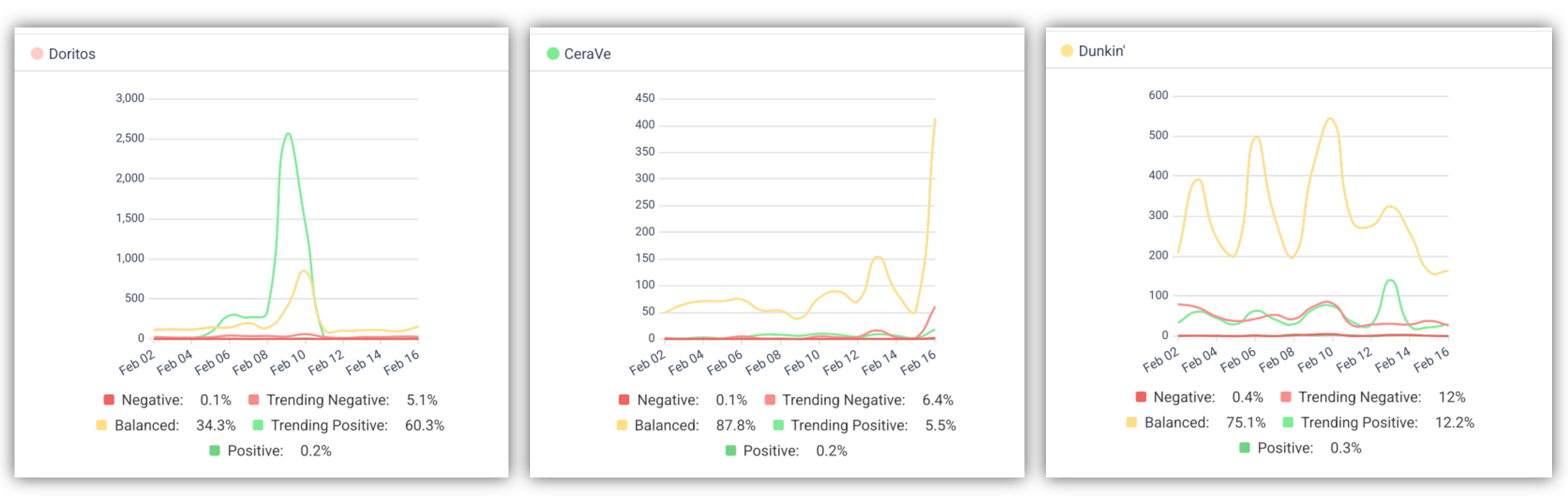
Caption: Sentiment analysis from CisionOne's social listening dashboard show how audience feelings spiked for Doritos, CeraVe, and Dunkin' before during and after last year's Super Bowl.
Final thoughts: Re-creating Super Bowl success all year long
While your brand might not be competing for prime Super Bowl spots, the underlying strategies for building anticipation, leveraging authentic voices, and sustaining momentum are universal. By adopting these "long-tail" PR tactics, any brand can transform a one-time announcement into a powerful, enduring campaign that captivates audiences long after the initial buzz.
Find out more about how CisionOne can help you plan and monitor your next winning campaign strategy. Speak to an expert.